While some tree companies still utilize only basic equipment like chainsaws and ladders, modern services at the cutting edge of tree removal technology have invested in cranes to expedite removal and protect surrounding areas by utilizing a tree removal crane. Cranes offer several key advantages over traditional tree takedown methods, resulting in safe tree removals completed as efficiently as possible.
Crane removals can:
- Allow access to hard-to-reach trees
- Allow hazardous trees to be removed safely
- Be coupled with additional technologies to enhance safety and efficacy
This article will explore the advantages of crane removal over traditional tree removal methods and explain why services that utilize a tree removal crane are better equipped to handle tree removals of all types.
When Is a Crane Required for Tree Removal?
A crane is required when a tree can’t be taken down safely by climbing or felling alone — usually because of where it sits, what condition it’s in, or how big it is. Not every removal needs one, though, and we’ll always recommend the method that’s safest and most efficient for your specific tree.
Signs Your Tree Removal Needs a Crane:
- The tree is in a tight spot or has no safe place to drop limbs, like one hanging over your house, garage, or pool, or wedged between buildings.
- The tree is dead or dying, diseased, or storm-damaged and too unstable to climb.
- The tree is simply too tall or too large for a climbing crew to handle on its own.
Common Tree Types in MetroWest that Require a Crane
Across MetroWest, a handful of trees account for most of our crane removals.
- Dead Ash Trees: Killed by the emerald ash borer, ash wood turns so brittle it can snap without warning, making it unsafe to climb. Removing a dead ash tree safely takes a specific process and the right equipment.
- Towering White Pines: Some of the tallest trees in the area, they routinely exceed the safe working height for a climbing crew.
- Large Oaks and Maples Over Structures: Big hardwoods leaning over a house, driveway, or pool rarely have a safe drop zone, so sections have to be lifted away.
Is a Crane Ever Optional?
A crane is optional when a healthy tree stands in an open yard with plenty of room. In that case, traditional climbing or felling can be just as safe and may cost less. Either way, owning a crane doesn’t automatically make a company skilled, so it’s worth checking a company’s experience, recommendations, and proper insurance before you hire.
If you’re not sure which approach your tree needs, it helps to know when crane tree removal in MetroWest makes sense and what the work involves. We’ll also figure it out with you during the free, on-site estimate, where we look at the tree, the property, and the access before recommending an approach.
Can a Crane Remove a Tree in a Tight or Hard-to-Reach Spot?
Yes, and it’s often the safest way to do it. Felling a tree the traditional way needs a clear drop zone about twice the tree’s height in every direction, so a 50-foot tree calls for roughly 100 feet of open space. In the Hopkinton area, that much room is rare, so a crane earns its keep by lifting the tree out in sections instead of dropping it.
Here’s how a crane handles a tight site:
- It Works Straight Up and Down: Sections are cut and lifted vertically out of the area, even when buildings, roads, power lines, or people leave no room to drop limbs.
- It Protects What’s Around the Tree. Lifting each piece clear instead of dropping it cuts the risk of damage to structures and landscaping, and we set sections down right where we want them, on a driveway, road, or protected patch of lawn.
- It Reaches Over Obstacles: The boom can hoist sections, and even equipment like stump grinders, up and over things that would otherwise block removal. It’s not unusual for us to park out front and reach a tree in the backyard.
That makes a crane ideal for congested neighborhoods, tightly packed lots, and tricky spots like behind a building or near water.
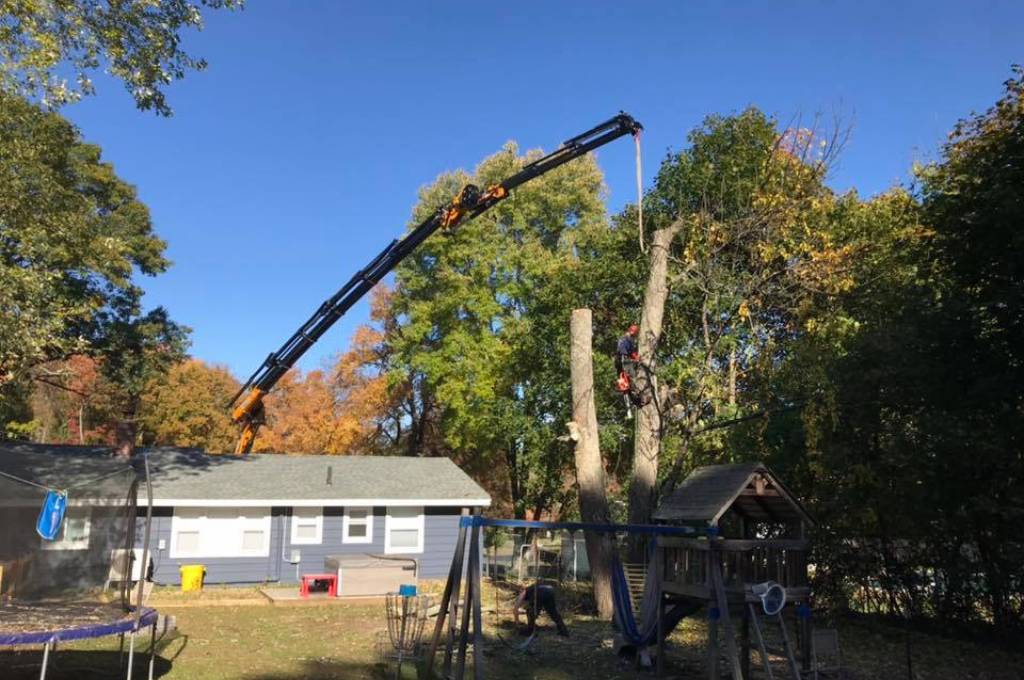
Tree removal cranes can access hard-to-reach areas, making tree removals more efficient and maximizing safety.
Why Use a Crane to Remove a Hazardous Tree?
When a tree is too unstable to climb, a crane is the safest way to take it down, because it keeps the crew off the tree and lifts each section away under control. A tree that’s structurally unsound from storm damage, disease, or pests (such as the emerald ash borer) can fail without warning and hurt the climber above or the crew below. Felling it is no safer, since there’s no guarantee where the tree will land, and the cut end of the trunk can kick out and strike anyone nearby.
Using the crane’s reach to dismantle the tree and lift each section away avoids much of the hands-on climbing and chainsaw work that, while usually safe, still carries risk. When a climber does go up as part of a crane removal, they can secure each section before any cut is made, and with the right rigging the ground crew can guide heavy pieces gently to the ground.
That control is why few tree services will take on a hazardous or hard-to-reach removal without a crane. A company can attempt it, but the risk is high, and a service without a crane may not be able to handle your removal as safely as a crew that has one.
Why Does Crane Tree Removal Require a Trained, Licensed Crew?
Crane tree removal takes a trained, licensed crew because the work leaves no margin for error — a crane lifting heavy tree sections near homes, power lines, and people is only as safe as the team running it. A smooth crane removal can make it look easy, but a poorly run one puts everyone nearby at risk.
Setting up the crane, rigging each cut, and coordinating the lift all take practice, so it pays to understand how crane tree removal works and to hire a crew that does it day in and day out. That experience should come with credentials, too. In Massachusetts, anyone operating hoisting equipment also has to hold a license from the Office of Public Safety and Inspections, so confirm the company you hire meets that requirement, carries proper insurance, and has a solid track record before the work begins.
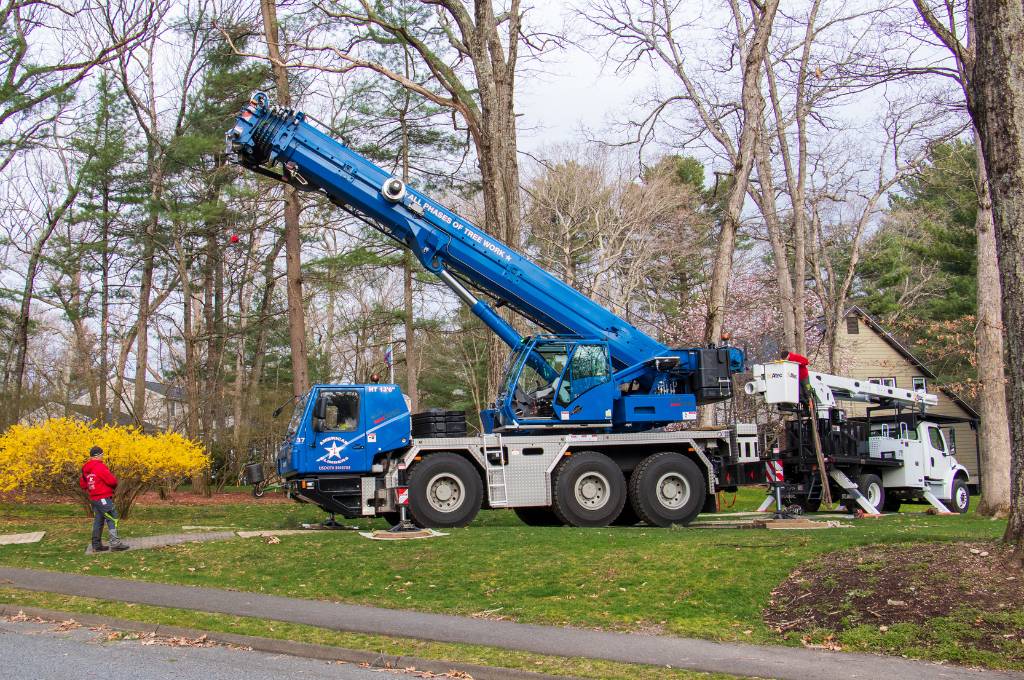
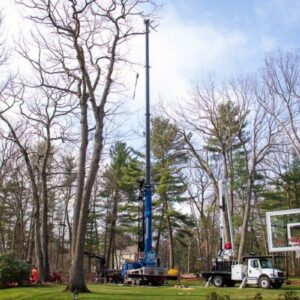
The American Climbers crane is ready to get to work. Notice the extended outrigger supports used to stabilize the crane.
Frequently Asked Questions About Hiring a Crane for Tree Removal
Can a tree service remove a tree without a crane?
Yes, many trees are removed without a crane. When a tree is healthy and has open space around it, a trained crew can climb and rig it down or fell it in one piece. The catch is that not every company has the equipment or experience for hazardous, oversized, or tight-access trees, which is where a crane and a skilled operator make the difference.
Is crane tree removal safer than traditional removal?
In certain situations, yes. For a tree hanging over your house, a brittle dead ash, or a tree wedged in a tight space, a crane is safer because it keeps our crew off unstable wood and gives us far more control over where each section goes. For a healthy tree in an open yard, traditional climbing and felling are also very safe. A crane isn’t automatically safer in every case. It’s the safer choice when the tree or the site makes climbing risky.
Does using a crane damage my lawn or driveway?
We take real steps to protect your property, so damage is uncommon. The crane’s outriggers spread its weight over a wide area, and we place pads and mats under them and over soft ground to prevent ruts and cracks. Whenever possible, we set up on the driveway or street rather than the lawn, and your estimator will walk through any concerns with you before the work begins.
Does crane tree removal cost more than other methods?
Not always, and sometimes it costs less. Because a crane can turn a multi-day job into a few hours and cut down on labor, the total often comes out close to a traditional removal on complex trees. What you’ll pay for crane tree removal in MetroWest comes down to the tree, its condition, and how easy it is to reach.
Is it safe to remove a tree near power lines with a crane?
It can be, with the right planning and crew. Trees tangled in power lines are extremely dangerous and call for careful coordination, and sometimes the utility company has to be involved first. We assess each situation and choose the safest way of removing a tree near power lines.
What should I do if a tree has fallen on or is leaning against my house?
Stay clear of it and call for emergency tree service right away. A tree resting on a structure is under tension and can shift or fall further without warning, so it isn’t something to handle yourself. American Climbers handles emergency and storm-damage removal, and a crane is often the safest way to lift a fallen tree off a home.
Need a Crane to Remove Your Tree?
The experts at American Climbers are ready to leverage the latest tech to take care of your removal quickly, efficiently, and safely with our cranes, knuckle booms, robotic Tree-Mek, and grapple saw. Call us today at 508-497-8628 to schedule your tree removal!
We proudly serve Metro-West Massachusetts, including Hopkinton and surrounding areas!
Blog Topics
Recent Posts

What's Happening? Stay Informed!
Stay on top of local events, pest and disease updates, tree and landscape tips, and more. Delivered straight to your inbox each month.