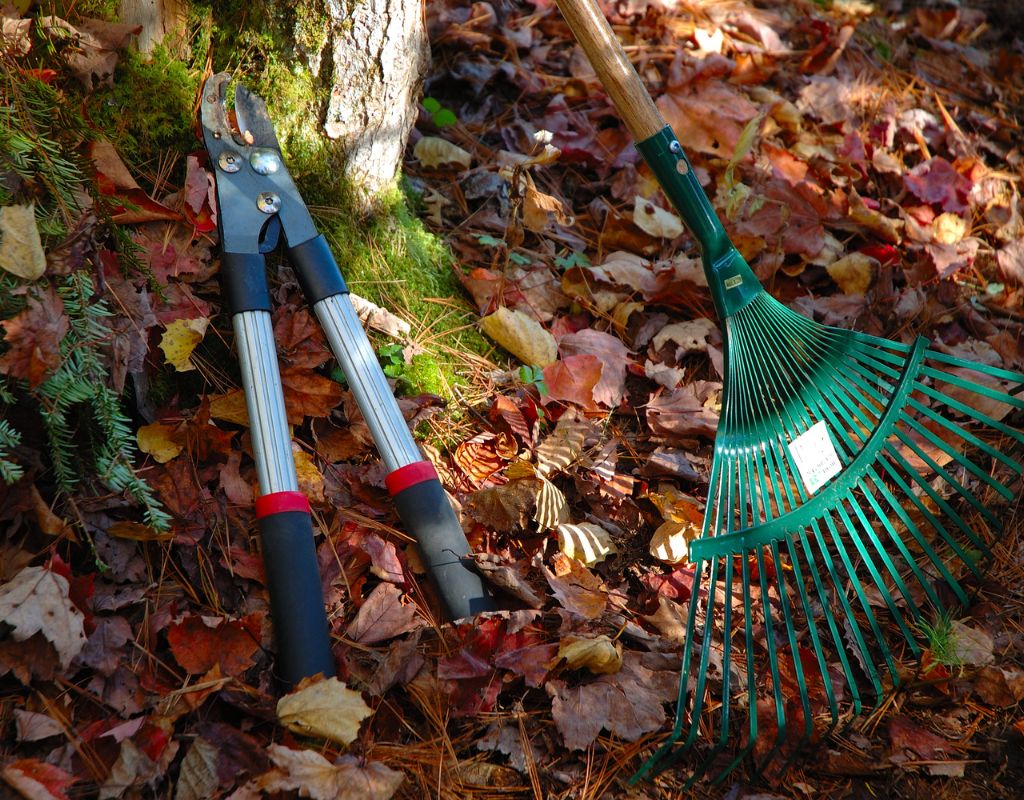

If you’ve never seen a tree removal before, you may picture a tree that is cut near the base as workers yell, “timber!” and the entire tree tips and crashes to the ground.
While this is still a viable (if dangerous) method to remove some trees, it isn’t always possible or safe to remove them this way in neighborhoods or near buildings, roads, or landscaped areas.
Instead, we utilize specialized equipment, including cranes, to remove trees section by section. In this article, we’ll go over some of the specifics as to why, how, and when we use cranes for removing trees.
Is a Tree Removal Crane the Same Type as Used in Construction?
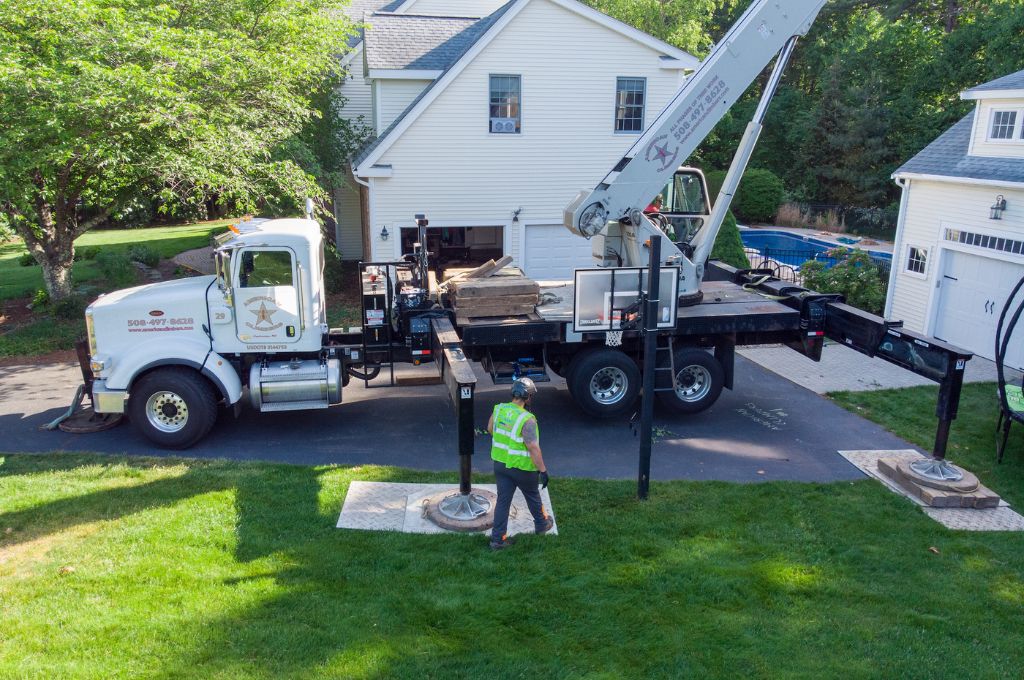
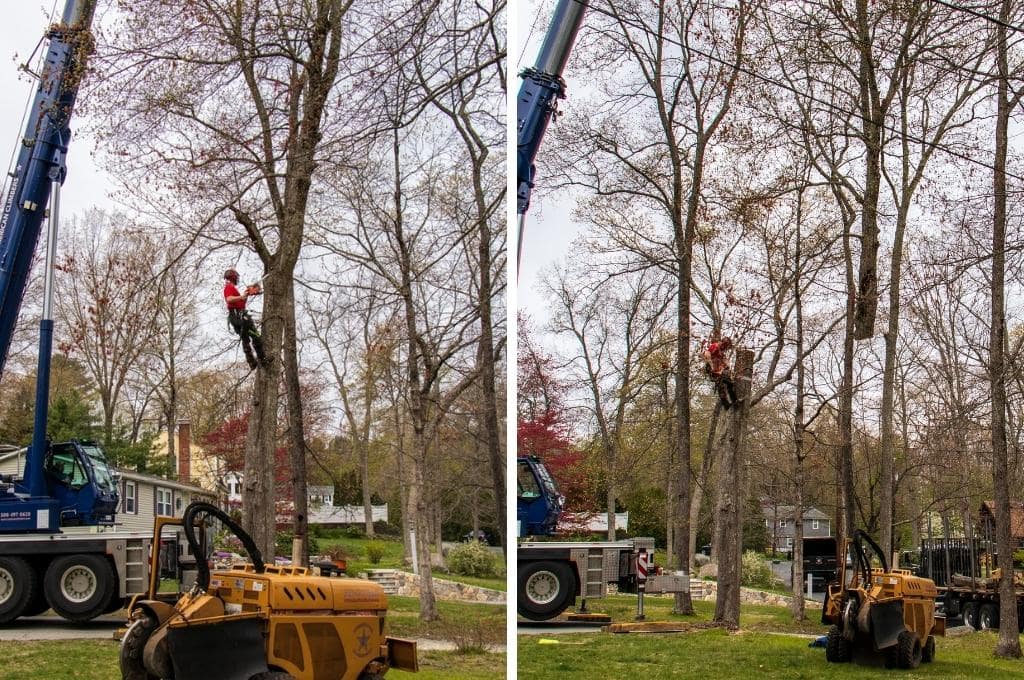
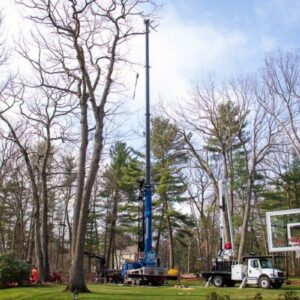
No, tree removal cranes are specially made for the arboriculture (tree care) industry. While cranes used in construction are stationary, tree cranes are part of a vehicle, which allows us to use the crane in almost any environment. It’s also why you may see the American Climbers crew taking some time to correctly position and stabilize the crane – we need to ensure it won’t move.
This stage can take a while when the crane is parked on hills or sloping areas. We also need to consider the location and size of the tree being removed, obstacles, and some other factors.
Totally professional. They worked like a well-oiled machine. Everyone knowing just what to do to get the job done in an excellent manner. Love them, would use them again in a heartbeat. American Climbers are the best! – Donna O., American Climbers customer
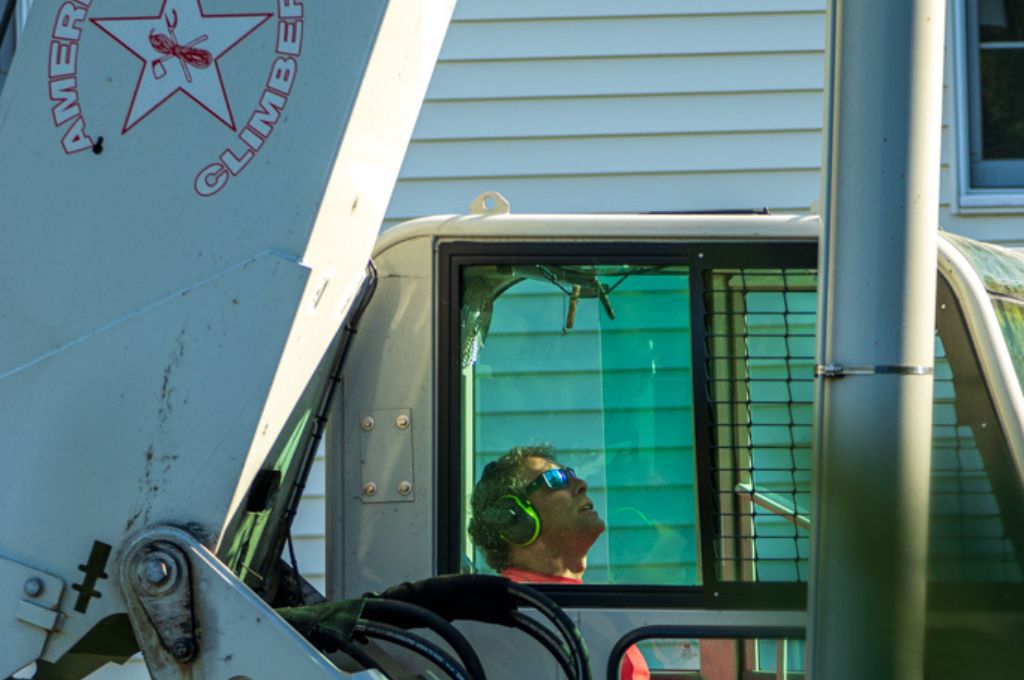
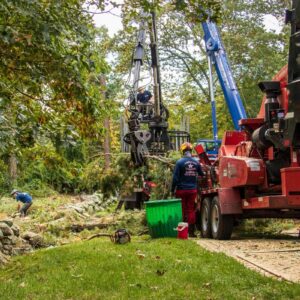
Once we are ready to work, a crane operator sits in the cab of the crane and uses the boom to lift a climber into the tree. The climber moves to a safe section of the tree and secures themselves there, and then attaches the crane to a section of the tree which the climber cuts with a chainsaw.
Using various methods of communicating with the crane operator, the climber lets the crane operator know that the section of the tree can be moved. The crane operator lifts and moves the cut section of the tree to a different location, where the ground crew takes over.
Trees removed by crane are usually removed top-down, as the crane allows our team to reach the tallest trees in our area.
A slightly different process is used if the tree is brittle, unstable, or decaying, as it may be unsafe for a climber.
Why does American Climbers use Cranes for Tree Removals?
There are multiple reasons for using a crane during a tree removal. It is safer for everyone involved can be faster than other methods, and causes less destruction to the surrounding area.
Using a Crane is Safer
We appreciate the work American Climbers did on our property. We had 2 codominant trees that had to be hoisted up over our house and they performed the job with ease. The crew was great and got the job done in a very safe and an efficient way. -Stephen T., American Climbers customer
When used correctly, use of a crane can make the process of removing a tree much safer than other methods. The American Climbers crew is thoroughly trained on how to use the equipment, how to communicate, and what each person’s job entails. Add that to the experience and knowledge from many tree removals with varying circumstances over the years, and you have one of the best-working crews in the industry.
This high level of safety and experience keeps not only our crew safe but the property owners, passersby, and anyone else nearby.
Felling trees can be very dangerous if done incorrectly. Not only is it not guaranteed where the tree will fall, but the bottom of the cut section of the tree can sometimes jut out and hurt anyone nearby.
Falling trees, heavy tree limbs, rotten sections of wood, sharp and powerful equipment, and tall heights all add to the safety concerns when working on trees. While using a crane doesn’t eliminate all of these concerns, it does mitigate some of them.
Using a Crane gets the Job Done More Quickly
American Climbers were a great value with exceptional quality and service. Very professional and speedy handling of a tree removal on a fairly busy street. They were in and out before we knew it with no mess. Thank you! – Eric Z., American Climbers customer
It can take a while to set up a crane so that it is perfectly balanced (we don’t want it to tip over!), but once everything is in place and each team member understands how the job will play out, using a crane to remove sections of a tree can be a much quicker process than you may think.
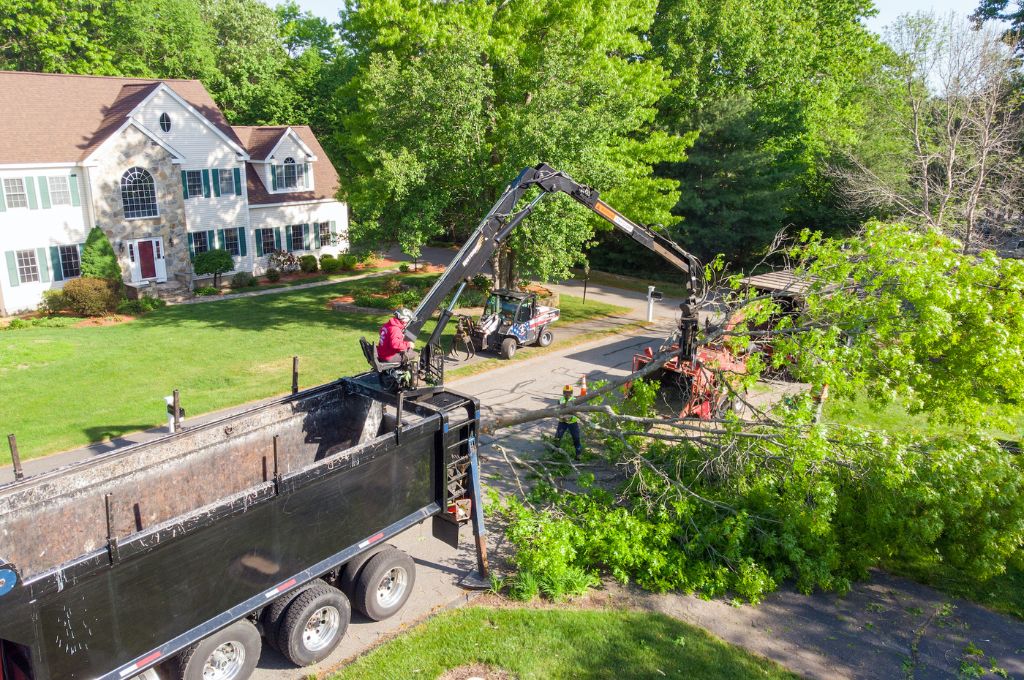
Use of a crane allows us to move large, extremely heavy sections of trees from the tree to the ground, where our ground crew then removes the leaves and branches (which get run through the chipper), while the remaining logs are moved to the log truck.
It works as a sort of choreographed dance, with each crew member knowing their role and working together to complete the task. Since everyone knows their role well, the job might take several hours instead of several days.
Using a Crane for Tree Removals is Less Destructive
As with the first time I had American Climbers remove trees on the property, they were efficient, careful and thorough. This last time they removed very large trees very close to my gardens and I was shocked at how little disturbance occurred in the gardens. Also, all branches, leaves and sawdust was removed. I'll use them again. – Len E., American Climbers customer
As we mentioned at the beginning of this article, cutting a tree at the base and letting it fall, called “tree felling,” can destroy anything around it. In fact, it’s recommended that the drop zone (where the tree might fall) is twice the height of the tree in all directions. That means that there is a possibility that a 50-foot-tall tree could fall 100 feet away from where the tree was cut. There are specific cuts and safety measures to minimize this risk, but it is always a possibility.
By contrast, a tree removed by crane is removed in sections, and those sections are often moved to a driveway, road, or protected section of lawn.
Using a Crane for Tree Removals Allows Us to Reach More Trees
I felt that American Climbers were the most reliable local tree service not only because of their technical competence vs. a pretty tough tree removal problem, but more so because I could trust them to professionally handle the delicate situation of those trees overhanging a neighboring property. They met my high expectations. This is the 3rd time American Climbers has brought a crane onto, what seems to me to be, a nightmare of wires and buildings, and left the job site in better shape than when they arrived. From the main office to the sawyers, American Climbers employees have impressed me as polite, considerate, and alert to everyone's safety. A super high grade from me. – John L., American Climbers customer
One of the benefits of using a crane is how it allows the American Climbers crew to reach the trees themselves. We have a lot of tall trees in Massachusetts, and while we can utilize a bucket truck for some of them, a crane is able to reach much taller heights than other pieces of equipment.
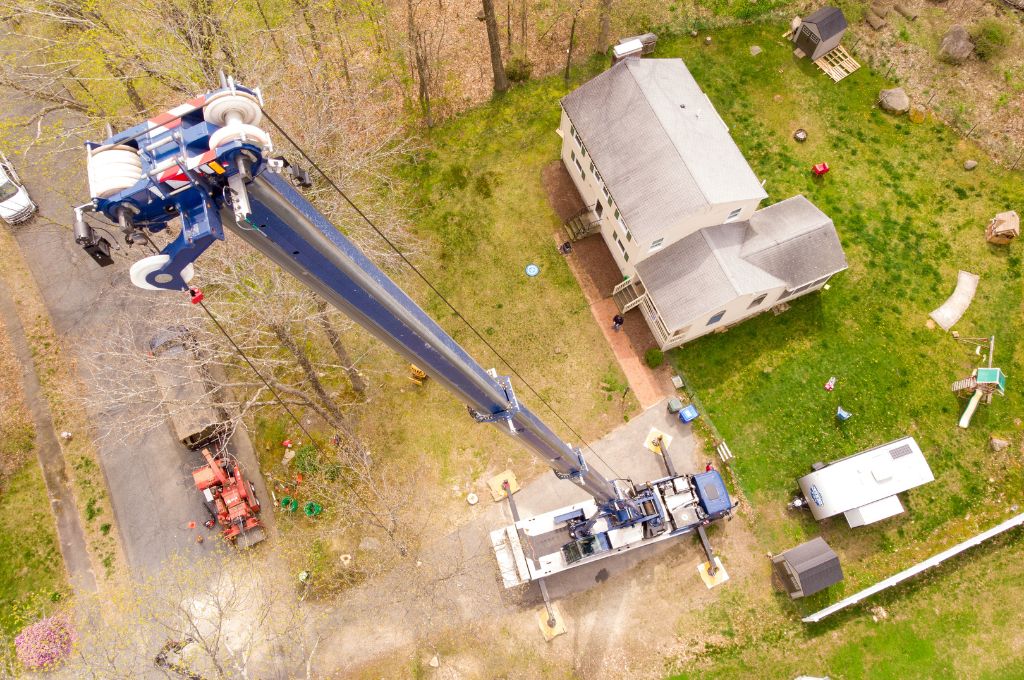
Use of a crane also allows us to reach trees in difficult locations. It’s not uncommon for the crane to be parked in front of a house while we use the boom section (the arm of the crane) to remove a tree from the backyard!
In Which Tree Removal Circumstances Can the Use of a Crane Be Beneficial?
Every tree, each location, and all jobs are different (which is why we need to see the trees first before we can give you an accurate quote), but in many cases, we will utilize a tree crane for removals. They can be particularly helpful when we are removing:
- Tall/large trees
- Dying trees (EAB)
- Trees near power lines
- Storm-damaged trees
- Trees in confined spaces
- Dead or dying trees
Click on any of the situations above to read more details.
When is a tree removal crane not helpful?
There are situations where using a crane may not be the best option.
If a tree company and its employees are not properly trained on how to use a tree crane, it can do more harm than good. The crane could tip if not balanced correctly, climbers could get injured in the trees, sections of trees could fall, and injuries from equipment or vehicles could occur.
Owning a crane does not guarantee that a company is skilled at tree work. Instead, check for certifications, proper insurance, experience, and recommendations from organizations and others.
If the tree that is being removed is small, a crane may not be beneficial. The American Climbers crew may utilize other methods of removal for small or young trees.
In some circumstances, we may determine that another piece of equipment, such as a grapple saw, could do the job better than the crane or that it is unsafe to use the crane. Again, you can rely on American Climbers’ knowledge and experience to choose the best method of removing your trees.
Wondering About Tree Removal?
If you have a tree that needs to be removed, contact American Climbers for a tree estimate. We will come to your property to assess the tree, its condition, the location, and more.
Learn more about our tree removal services.
Whether or not a crane pulls up on the day of your tree removal, you can be confident that the American Climbers team will ensure that your tree is removed safely, efficiently, quickly, and cleanly.
Blog Topics
Recent Posts

What's Happening? Stay Informed!
Stay on top of local events, pest and disease updates, tree and landscape tips, and more. Delivered straight to your inbox each month.